
Moody's Ratings on Wednesday said India's economic growth will exceed 6.5 per cent in the next fiscal, up from 6.3 per cent this year, on higher government capex and consumption boost from tax cuts and interest rate reduction. Projecting a stable outlook for the banking sector, Moody's said although the operating environment of Indian banks will remain favourable in the next fiscal, their asset quality will deteriorate moderately after substantial improvements in recent years, with some stress in unsecured retail loans, microfinance loans and small business loans.

TCS was the biggest loser in the Sensex pack, sliding 3.17 per cent, followed by HCL Tech, Yes Bank, IndusInd Bank, RIL, ICICI Bank, Infosys, Tata Steel, Kotak Bank and L&T, down up to 2.34 per cent.

Reserve Bank of India Governor Raghuram Rajan said, in an election year, it is better to be ready for any eventuality.
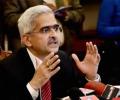
All members of the Monetary Policy Committee (MPC) -- Shashanka Bhide, Ashima Goyal, Jayanth R Varma, Mridul K Saggar, Michael Debabrata Patra and Shaktikanta Das -- had unanimously voted to keep the policy repo rate unchanged at 4 per cent after the three-day meet of the panel earlier this month. Further, except Varma, other members voted to continue with the accommodative stance as long as necessary to revive and sustain growth on a durable basis and continue to mitigate the impact of COVID-19 on the economy, while ensuring that inflation remains within the target going forward. Varma expressed reservations on this part of the MPC resolution, according to the minutes.

While the RBI, in the recent past, appeared keen to move to an inflation-targeting framework, industry and academia remain divided on this issue.

With the RBI infusing Rs 7.5 lakh crore in liquidity -- and possibly more in the future -- the short- to medium-term corporate bond market is expected to benefit.
The Reserve Bank of India's move to pause its hawkish Monetary Policy stance is on expected lines as high interest rates affect the economic growth, bankers and analysts said.

The rupee tumbled 3 per cent against the US dollar in 2024 as concerns over slower economic growth and a stronger greenback in global markets weighed, but it was among the least volatile currencies in the world and the headwinds may be less intense in the coming year.
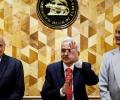
'The central bank has highlighted that the slowdown in growth has been limited to a few sectors and overall growth is expected to pick up in the second half of the year.'

In response to the panic triggered by Trump's trade policies, the RBI net sold approximately $43 billion in the second half of FY25 to curb volatility, as the rupee plunged to a low of 87.95 per dollar in February this year.
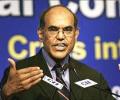
A revival in investment activity, which is key to stimulating growth, depends particularly on the recent policy announcements by the government being translated into effective actions, Subbarao said while announcing the second quarterly review of the monetary policy.
The Reserve Bank of India on Tuesday said it was starting to unwind some of the extraordinary policy easing and liquidity support measures taken to shore the economy up against the global credit crisis and economic slump.

In the global context, the country "stands out" in terms of relatively stronger growth and improved economic fundamentals, Raghuram Rajan said.

Dr Nagesh Kumar, one of the three new MPC members, wanted the MPC to reduce the repo rate by 25 basis points to 6.25%.

All six members of the Reserve Bank of India's (RBI's) monetary policy committee (MPC) expressed caution over food inflation during the December review, while two external members warned about high real interest rates as headline inflation approaches its target of 4 per cent. The central bank continued to maintain the status quo on both the repo rate and the stance in the December monetary policy. India's retail inflation in November rose to 5.5 per cent - its fastest pace in three months - due to higher food prices.

'We continue to view India as a standout within EM.'

In trade negotiations, as in chess, sometimes you need to accept a temporary disadvantage to secure a better long-term position, points out Sonal Varma, chief economist (India and Asia ex-Japan) at Nomura.

To minimise risk, invest in a debt fund whose duration matches your investment timeframe.
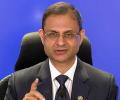
'We will be very, very proactive in providing whatever liquidity requirements are needed.'

Shares of state-owned bank stocks were under pressure on Monday due to muted deposit and credit growth numbers reported by these lenders in the October-December quarter (Q3) of 2024-25 (FY25). The Nifty PSU Bank index was down 4 per cent, with Union Bank of India emerging as the biggest loser as its shares fell 7.5 per cent to close at Rs 114.7, followed by a 5.7 per cent drop in shares of Bank of Baroda (BoB) to Rs 228 and a 4.7 per cent slide in shares of Bank of India to Rs 99.8 on the National Stock Exchange.

From the Sensex pack, Bajaj Finserv, Mahindra & Mahindra, Axis Bank, Bajaj Finance, Adani Ports, ICICI Bank, Zomato and UltraTech Cement were among the biggest gainers. However, ITC, Nestle, State Bank of India, Reliance Industries, Asian Paints and Tata Consultancy Services were among the laggards.

'The RBI's MPC will maintain the current policy rates (6.50%) at the policy meeting, given ongoing inflationary pressures.'

Since Sanjay Malhotra took office as governor in December, the Reserve Bank of India (RBI) has adopted a more accommodative stance, which bodes well for banking and the economy as they navigate a growth slowdown, according to analysts.

ICICI Bank and SBI were among the top Sensex gainers along with FMCG majors ITC and HUL.
Reserve Bank of India (RBI) Governor Sanjay Malhotra said the repo rate cut in the February meeting of the monetary policy committee (MPC) was due to inflation aligning with the target and recognising the fact that monetary policy is forward-looking.
RBI is likely to continue with its tight monetary policy.

Deputy Governor Michael Patra warned about the spillover effects of food inflation.

Reserve Bank of India (RBI) is unlikely to cut the benchmark interest rate at its upcoming monetary policy review meeting, taking place soon after the announcement of the Lok Sabha election results, amid inflation challenges, said experts. The Monetary Policy Committee (MPC) may also refrain from rate cut as economic growth is picking up, notwithstanding the elevated interest rate of 6.5 per cent (repo) prevailing since February 2023. The meeting of the Reserve Bank Governor Shaktikanta Das headed MPC is scheduled for June 5 to 7.

The Reserve Bank is likely to maintain status-quo on the key interest rates for the third time in a row in its upcoming bi-monthly policy review despite the US Federal Reserve and the European Central Bank hiking benchmark rates, as domestic inflation is within the RBI's comfort zone, say experts. The borrowing cost which started rising in May last year has stabilised with RBI keeping the repo rate unchanged at 6.5 per cent since February when it was raised from 6.25 per cent. In the previous two bi-monthly policy reviews in April and June the benchmark rate was retained.
The Reserve Bank of India (RBI) is expected to cut interest rates for the first time in nearly five years in Governor Sanjay Malhotra's first monetary policy committee (MPC) meeting on Wednesday. The meeting of the six-member MPC, which will culminate on Friday, aims to boost sluggish economic growth, which is seen falling to a four-year low. Malhotra took charge as the 26th RBI governor in December last year.

Amid expectations that the Reserve Bank may keep its monetary stance unchanged, the central bank will come out with its second quarter review of the credit policy for the current fiscal on October 27.

Sanjay Malhotra takes charge as the 26th RBI governor at a time when headline retail inflation has shot up to 6.2%.

SBI was the top gainer in the Sensex pack, spurting over 2 per cent, followed by ICICI Bank, Nestle India, IndusInd Bank, M&M, Bajaj Auto and Maruti. NSE Nifty advanced 135.55 points to 14,819.05.

Chidambaram was apparently upset over RBI's decision to leave interest rates unchanged on inflation concerns despite the government unveiling a five-year fiscal consolidation road map ahead of the policy.

Gold prices are expected to witness further consolidation in the coming week as investors brace for a slew of events, ranging from central bank meetings, including the US Federal Open Market Committee (FOMC) meeting's outcome, to global trade negotiations, analysts said.

The Reserve Bank of India's (RBI's) State of the Economy report for October acknowledged a slowdown in some high-frequency indicators but expressed confidence in a recovery, aided by consumption demand during the festival season. "In India, aggregate demand is poised to shrug off the temporary slowdown in momentum in the second quarter of 2024-25 as festival demand picks up pace and consumer confidence improves," said the report released on Monday.
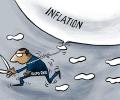
'As the Budget has taken some measures to spur growth, similar action from the MPC may be expected.'

Short-term lending (Repo) rate is unchanged at 8 per cent.

Indian economy is in a sweet spot, with a mix of solid growth and moderating inflation, Moody's Ratings said, forecasting a 7.2 per cent GDP growth in the 2024 calendar year and 6.6 per cent in the next. In its Global Macro Outlook 2025-26, the rating agency said the global economy has shown remarkable resilience in bouncing back from supply chain disruptions during the pandemic, an energy and food crisis after the Russia-Ukraine war began, high inflation and consequent monetary policy tightening.
Govt likely to get full control on policy rate.
